








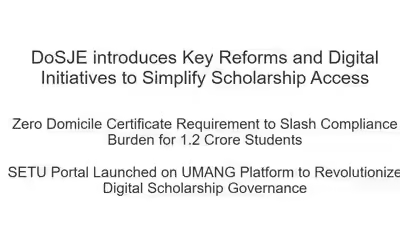
The Department of Social Justice and Empowerment (DoSJE) has launched a slew of reforms and digital initiatives aimed at making scholarship schemes more accessible to Scheduled Caste (SC) and Other Backward Class (OBC) students across the country.One of the biggest changes is the elimination of the proof of residency requirement for students applying under the department’s scholarship program. The move is expected to reduce paperwork and make the application process simpler for students seeking financial aid.The department said the change would particularly help students educated outside the state. Previously, to avail benefits under these schemes, one had to submit proof of residence.The reforms cover matriculation and matriculation scholarship schemes for SC and OBC students. Nearly 120,000 students receive benefits under these programs each year. By eliminating the proof of residence requirement, students will have to submit fewer documents and the cost of compliance will be reduced.The department said the move is expected to make the application process more student-friendly and improve eligible students’ chances of receiving scholarships.In addition to reforms, the department also launched SETU (Scholarship for Transformation and Upgradation of Education) on the UMANG platform. The new portal is designed as a single window system for scholarship related services.SETU will provide a common interface to applicants, agency nodal officers, district nodal officers and state officials. The platform will support services such as application registration, tracking and verification, aiming to increase transparency and efficiency in scholarship management.The department said the initiatives are in line with the government’s objectives of promoting inclusivity, reducing procedural barriers and ensuring the effective delivery of welfare programmes. It added that technology-driven reforms will continue to be used to improve outreach and provide timely support to students.