








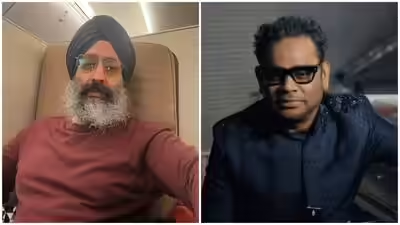
Singer-songwriter Rabbi Shergill, best known for Bulla Ki Jaana and Tere Bin, shared his views on music composer AR Rahman’s recent comments that show the communal bias in the entertainment industry, saying it is difficult to ignore the larger socio-political reality.Speaking in an interview on The Life Savers Show, Rabbi said he did not know the exact context in which Rahman made the statement but believed that the concern could not be ruled out.“I don’t know in what context he said that, but how can you deny that now? How can you deny the communal angle?” Rabbi said:He clarified that he cannot specifically comment on whether there is such a bias in the music industry as he is not based in Mumbai.“I wouldn’t specifically say it’s in the music industry because I don’t live in Mumbai or interact with people on a daily basis.Referring to films like The Kashmir Files and The Kerala Story, Rabbi added, “These are political films and they don’t have to show an unbiased view of things. So when Rahman says it, I think you have to take him at his word. Maybe it exists, and that’s one of the biggest problems of our time.
“No one is immune to these global currents”
Asked if he saw this as part of a broader change in world politics, the Rabbi said that ideological changes are happening all over the world.“Absolutely. If you look back to the 1960s, left-leaning politics was influential in much of the world. Today, if you look around, you see right-wing governments and ideologies becoming more dominant in many countries. Maybe it’s cyclical and things will change again, but now nobody is immune to these global currents. “He added that the phenomenon is beyond India.“Absolutely not. Just look at our neighborhood. Pakistan has changed a lot over the decades. China is deeply ideological. Sri Lanka is also becoming more ideologically driven. It’s hard not to conclude that politics everywhere is moving in this direction.”
“We have become a centralized republic”
Sharing his views on the Indian political landscape, Rabbi said that power has become increasingly concentrated around individual leaders across parties.“We have become a centralized republic where every political party revolves around a dominant figure. Whether it is the Congress with the Gandhi family, the BJP with its central leadership, the Trinamool Congress, the Samajwadi Party, or even the regional parties—everywhere there is a clearly defined center of power.”He continued, “You can never oppose the central leadership and still remain within the party. The same thing happened in the Aam Aadmi Party. People like Prashant Bhushan and Yogendra Yadav, who were among those who helped build the party, were eventually expelled. That is the political reality today.”