







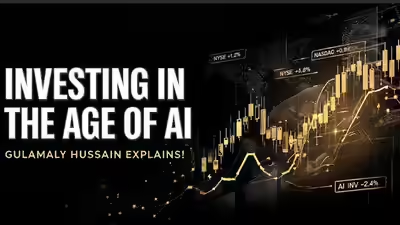
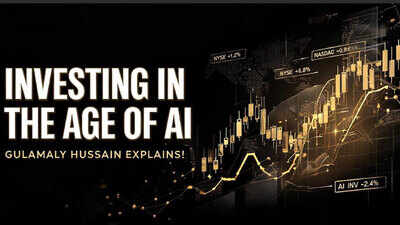
Senior banker and investor relations professional Gulamaly Hussain said in a recent virtual interaction with SMEs, start-ups and students that artificial intelligence has made investment research faster and easier, but it cannot replace human judgment, discipline and sound financial thinking.Talking about investment in the era of artificial intelligence, Gulamali Hussain said that technology should be used as a tool to improve research rather than as a shortcut for investment decisions. He explained that while AI can analyze annual reports, compare financial statements and identify market trends in minutes, it cannot predict management decisions, geopolitical events or changing market sentiments.“AI can significantly improve the efficiency of investment research, but it cannot replace human judgment, discipline or risk management. The best investors use AI to ask better questions rather than outsource their decision-making,” said Gulamali Hussain.During the conference, he highlighted the growing trend of retail investors relying on artificial intelligence tools to make stock recommendations without fully understanding a company’s fundamentals. Successful investments are always based on factors such as cash flow, earnings, valuation, governance and long-term growth potential, not just faster access to information, he said.Gulamaly Hussain warned attendees not to invest in companies just because they are part of the artificial intelligence industry. He said even strong businesses can become bad investments if bought at unrealistic valuations. He added that investors should always check whether revenue growth is sustainable, whether earnings justify valuations and whether the business is generating healthy cash flow before investing.He also discussed the role of artificial intelligence in analyzing mutual funds. He said that while AI can quickly compare returns, portfolio allocations, expense ratios and risk measures, it cannot determine whether a fund is suitable for an individual or organization’s financial goals, risk appetite and long-term investment strategy.Gulamaly Hussain warned participants about the risks of futures and options trading, referring to SEBI data showing that most retail traders lose money in the derivatives market. He said AI-generated trading signals and predictive models can create a false sense of confidence because markets are affected by factors that no technology can predict with certainty.To help viewers evaluate AI-based investment recommendations, Gulamaly Hussain introduces his “thinking framework” – test every AI recommendation, look for primary evidence, ignore market noise, never confuse probability with certainty, and maintain long-term discipline.“AI may help identify opportunities, but valuation determines returns. A great business bought at an unreasonable valuation can still become a disappointing investment,” he said.At the end of the interaction, Gulamali Hussain urged attendees to think of AI as an assistant rather than an advisor. “AI should augment investors’ thinking, not replace it. The best returns will go to those who combine technology with discipline, rather than those who rely solely on algorithms,” he said.